

The reception area is often one of the most sensitive points in a clinic’s operation: patients asking for information, professionals calling out names manually, lines forming during peak hours, and a team trying to stay organized while answering repetitive questions. In many clinics, the problem is not the number of appointments, but the lack of efficient visual communication within the operation itself.
When digital signage is properly implemented, the daily routine changes significantly. In this article, you will understand how digital signage improves workflow, organization, and patient experience, while also learning how to apply it practically in your clinic’s routine.
The problem with a disorganized reception area
Many clinics invest in infrastructure, staff, and healthcare technology, but still manage the reception area manually. This creates room for a negative experience for both patients and staff.
The reception area is the clinic’s first operational point of contact. When it conveys confusion, delays, or excessive disconnected information, the perception of care changes before the appointment even begins.
This usually appears in situations such as:
- patients being called out loudly
- lines of patients at the front desk asking basic questions
- professionals interrupting appointments to organize patient flow
In addition to the direct impact on care delivery, there is an operational consequence that must be considered: the staff spends energy on repetitive and easily automatable tasks. In multidisciplinary clinics, ABA centers, units with a high number of professionals, or operations with multiple rooms, small communication bottlenecks quickly turn into workflow problems.
If any of these situations are recurring in your clinic, it is time to take action.

Common mistakes in reception organization
Lack of clear signage
Patients arrive at the clinic and do not know where to go. This creates unnecessary movement of people looking for information and dependence on the reception staff for simple guidance.
Disorganized manual patient calls
It is still common to find clinics verbally calling patients from the reception area. Besides generating noise and a sense of disorganization, this process creates hearing difficulties, embarrassment, and delays in the clinic workflow.
Excessive dependence on the reception staff
When all communication depends exclusively on receptionists, any increase in demand generates operational overload. The team stops acting strategically and spends time solving small operational questions constantly.
Lack of integration between sectors
Many clinics have TVs or monitors without real integration into the operation. In this scenario, the equipment becomes only digital decoration, with no practical impact on the clinic’s workflow.
What works in practice
Clinics that operate in a more organized way usually do not rely only on staff. They structure visual and automated processes, and this starts with how the patient moves throughout the facility until the moment they leave.
Call panels integrated into the routine
Call panels help organize workflow without relying on constant verbal calls. Instead of the reception staff manually calling patients, the system organizes calls visually and in a standardized way.
This results in:
- less noise at the reception area
- fewer repetitive questions
- fewer interruptions
- less confusion
In addition, the environment becomes more comfortable and professional for patients waiting for care.
Ninsaúde Clinic offers this functionality fully integrated into the clinic operation, allowing patients to follow appointments in an organized and visual way — especially important in multidisciplinary clinics and operations with a high circulation of patients.

Displays on office doors
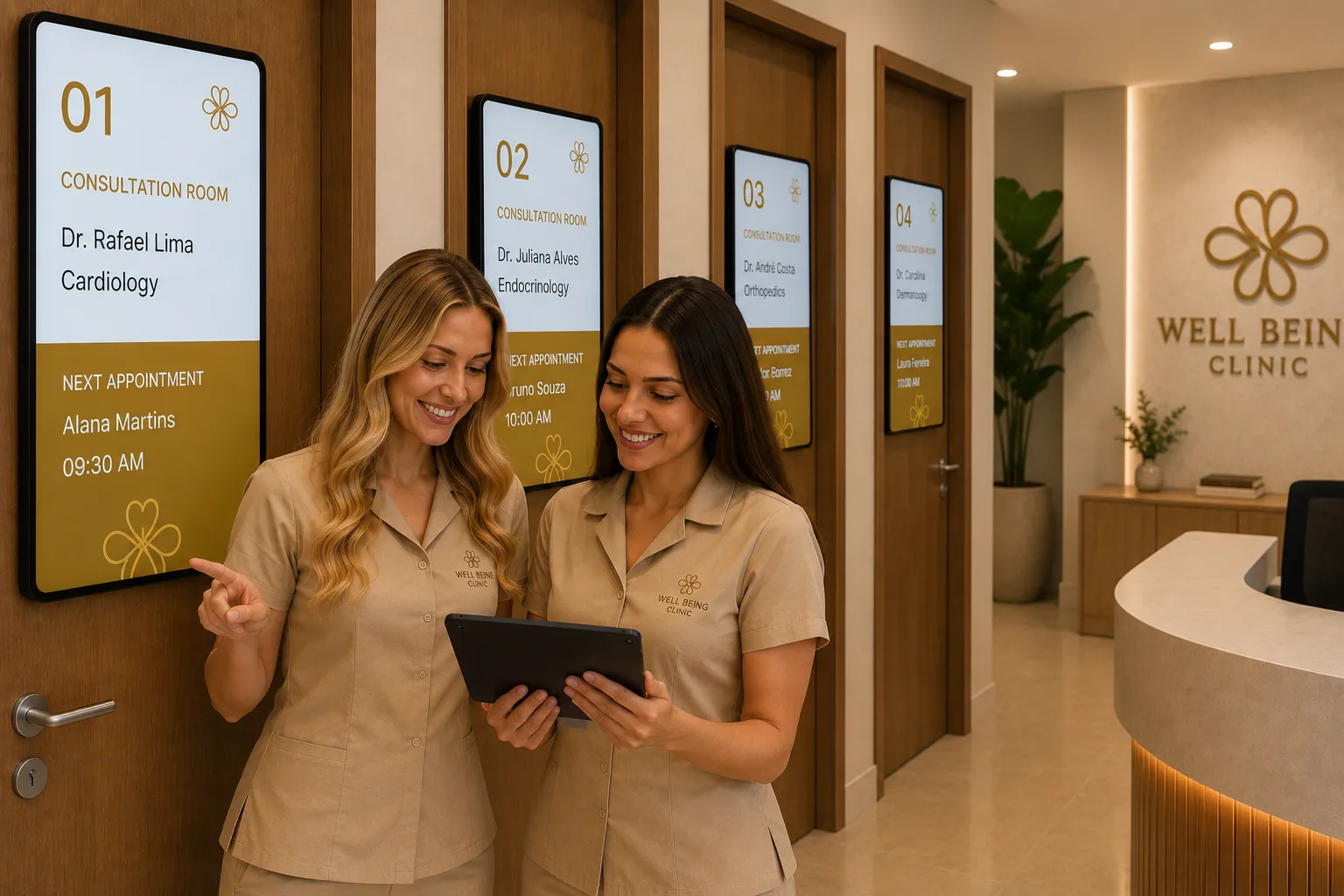
Another factor that greatly improves the patient experience is the visual identification of consultation rooms. When the clinic uses displays or tablets on room doors, patients can locate the correct consultation room without depending on the reception staff for every instruction.
With Ninsaúde Clinic, it is possible to use tablets fixed to consultation room doors as identification and patient care displays.
Synchronization is simple: just use a QR Code app to access the setup link in the browser and configure the tablet to keep the screen active.
In practice, this improves:
- internal organization
- room location
- patient autonomy
- workflow between reception and care
- perception of clinic modernization
And the operational impact is often greater than it seems.
Some time ago, we published an article specifically about using tablets as consultation room displays. Check it out by clicking here.

How to implement digital signage in your clinic
Step 1: map the reception’s most common questions
Observe which questions patients ask repeatedly.
Examples:
- Where should I wait?
- Which room will the appointment take place in?
- Which professional will assist me?
These points usually indicate failures in visual communication.
Step 2: automate patient calls
Replacing manual calls with digital panels immediately improves the organization of the environment. Besides the visual impact, the team gains operational time.
Step 3: use displays to guide patients
Tablets and displays help patients find their way around the clinic independently. This reduces unnecessary movement and prevents interruptions at the reception area.
Step 4: integrate everything into the clinic system
The big difference lies in integration. When panels, scheduling, and patient care operate in a connected way, the reception no longer depends on parallel processes.
This is what truly enables operational scalability.
The impact on clinic management
More productivity at the reception area: the team spends less time answering simple questions and can focus on more strategic tasks.
Better patient experience: quiet, organized environments with clear visual communication convey greater confidence and professionalism to patients seeking specialized care.
More scalable operations: the larger the clinic, the more important process standardization becomes. Digital signage helps maintain organization even as patient volume increases.
Fewer invisible bottlenecks: when the clinic reduces operational doubts, the entire workflow improves.
Is your reception area still operating by shouting names?
Many clinics believe the problem lies in the team or demand, when in fact the bottleneck is in how the operation was structured.
Visual processes, integrated communication, and operational automation are no longer differentiators. In clinics that grow in an organized way, these elements are already part of daily routine.
What changes when the patient experience begins before the appointment
Patient perception does not begin inside the consultation room. It starts the moment they enter the clinic.
Details such as a well-signaled workflow, a quiet environment, and an organized reception area convey confidence and improve the patient experience without requiring extra effort from the team. In practice, these details help clinics grow without reducing the quality of care.
Solutions such as Ninsaúde Clinic’s integrated call panels and displays show how small structural changes can generate a direct impact on productivity, organization, and the clinic’s perceived value.
Did you enjoy this information?
Keep following our blog for more content about healthcare management, medical marketing, and healthcare innovation.
Are you a healthcare professional and still unfamiliar with Ninsaúde Clinic? Discover how the platform can optimize processes and improve the quality of patient care.
