

Service agreements, informed consent forms, procedure authorizations, administrative documents, and registration forms need to be signed every day. Anyone who works in a healthcare practice knows one thing for certain: daily operations involve much more than simply providing patient care.
When these processes rely exclusively on paper, operations become slower, more vulnerable to misplaced documents, and much harder to organize.
Today, U.S. legislation recognizes the legal validity* of different types of electronic signatures in a variety of contexts, including healthcare-related documents, provided that the applicable legal requirements are met. The digitalization of these processes has become even more important with the expansion of telehealth and electronic health records.
We recently published a comprehensive article on this topic on our blog. Learn more about the legal validity of electronic signatures in the United States.
In this article, you'll learn when it's worth adopting electronic signatures in healthcare practices, the benefits they provide, the common mistakes to avoid, and how to implement this process securely using complete solutions such as Ninsaúde Sign.
Why do so many healthcare practices still depend on paper?
In many healthcare practices, the patient experience still begins with a clipboard full of documents. Paper after paper to sign, creating a process that often hinders rather than improves the patient experience.

For practices with multiple specialties, several locations, or a high patient volume, the problem quickly becomes even greater. Finding a consent form signed months ago can take considerable time—or may simply be impossible.
Electronic signatures help eliminate this friction by transforming paper documents into faster, more organized, and easier-to-manage digital workflows.
How do electronic signatures change this?
Centralizing documentation within the pactice management system
When contracts, consent forms, and authorizations remain linked to the patient's record, authorized staff members can quickly locate any document they need.
This eliminates the need to search through filing cabinets, paper folders, or multiple computers.
Using standardized document templates
Creating standardized templates for each type of appointment reduces errors and ensures greater consistency across documentation.
In addition, updates only need to be made once before becoming immediately available to the entire team.
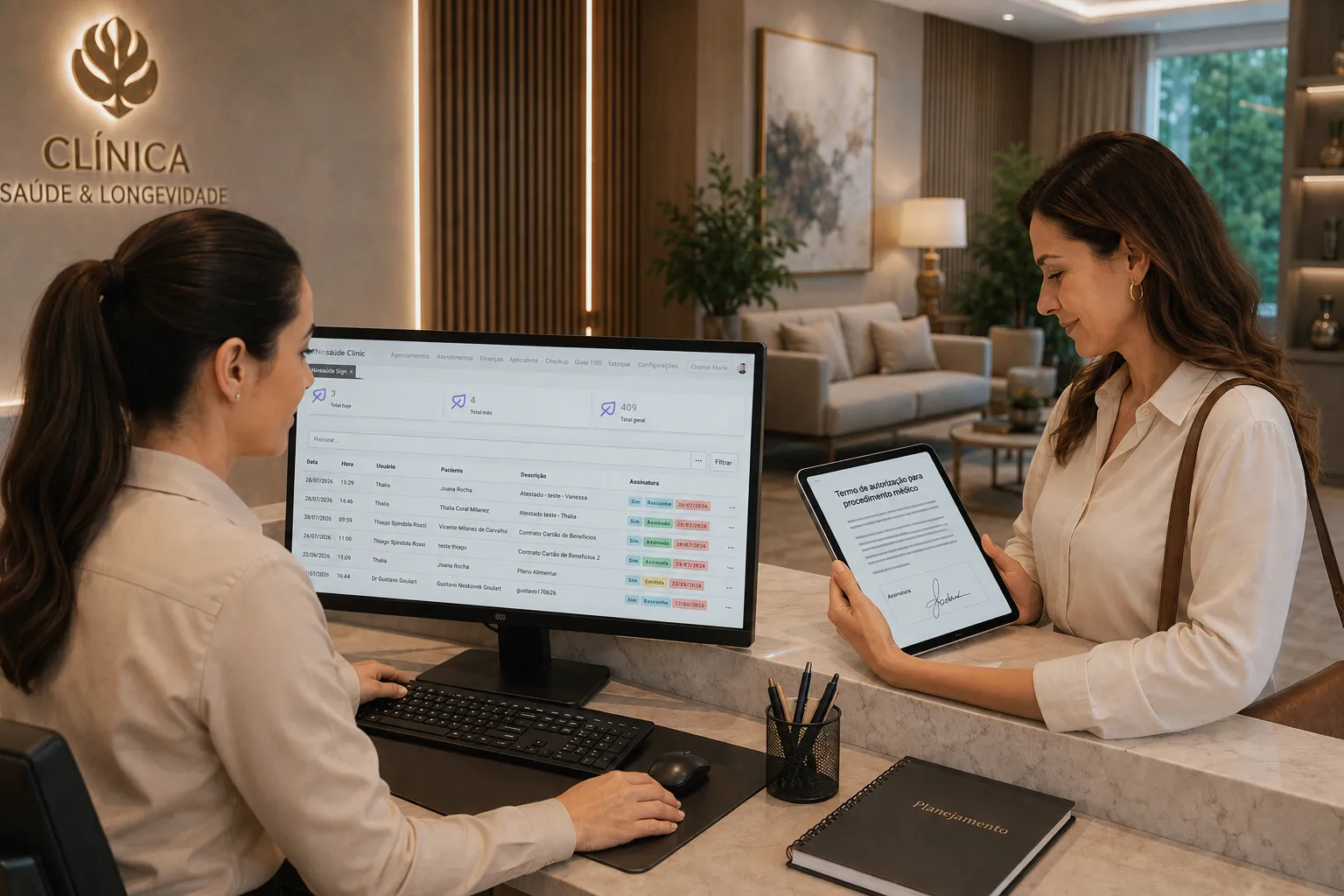
Signing documents digitally
Instead of printing, signing, and scanning documents again, patients can sign electronically during their appointment—or even before arriving—depending on the workflow established by the practice.
The entire process becomes significantly faster.
Integrating electronic signatures with the electronic health record (EHR)
When signed documents are automatically stored alongside the patient's medical record, staff eliminate unnecessary manual work while keeping all information centralized.
This is exactly where solutions like Ninsaúde Sign deliver value, allowing documents to be electronically signed and securely stored within the practice management platform, reducing manual steps and making information easier to access whenever needed.
Step by step: implementing electronic signatures in your practice
Step 1: identify which documents are signed most frequently
These typically include, but are not limited to:
- Informed consent forms;
- Contracts;
- Authorizations;
- Administrative documents;
- Patient registration forms.
This assessment helps identify where the greatest operational gains can be achieved.
Step 2: standardize your documents
Create official versions of every document used by the practice.
This simplifies future updates and reduces inconsistencies.
Step 3: digitize the entire workflow
Avoid creating workflows that are only partially digital.
The greatest benefits come when document generation, electronic signing, storage, and retrieval all take place within the same management system.
The impact of electronic signatures on healthcare practices
Financial impact
Reducing paper consumption, printing, physical storage, and repetitive administrative work helps lower operational costs over time.
Staff poductivity
Staff members spend less time printing documents, organizing paper files, and searching for old contracts.
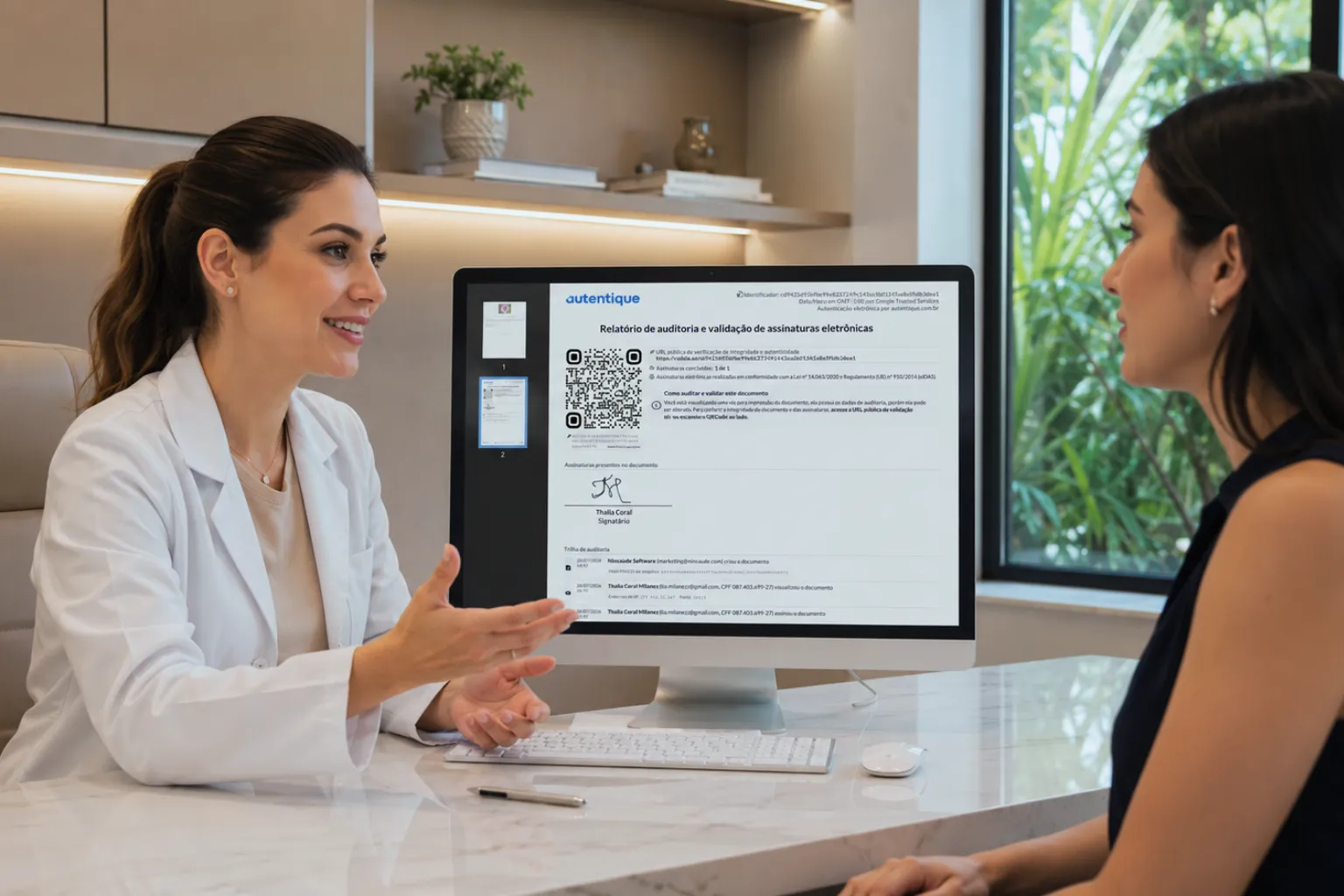
That time can instead be devoted to higher-value and higher-priority activities.
Patient experience
Less paperwork means a faster, smoother patient experience.
Patients perceive the practice as more organized, modern, and prepared to offer a digital healthcare journey.
Security and organization
Electronic documents can be securely stored in an organized structure, making audits, future consultations, and version control much easier.
In the United States, different forms of electronic signatures are legally recognized, and electronic healthcare documents may be considered legally valid when they comply with applicable federal and state regulations.
A turning point toward more efficient practice management

Electronic signatures reduce paper usage, accelerate internal workflows, improve document organization, and provide patients with a more modern experience.
When integrated into a practice management platform—as with Ninsaúde Sign—contracts, consent forms, and authorizations stop being bureaucratic paperwork and become a seamless part of the patient journey.

Did you find this information helpful?
Keep following our blog for more content about healthcare management, medical marketing, and healthcare innovation.
Are you a healthcare professional who hasn't discovered Ninsaúde Clinic yet? Learn how the platform can optimize your processes and help improve the quality of patient care.
