
Managing a healthcare clinic with more than one location can become challenging when each team works with separate information. Independent schedules, decentralized electronic health records, separate financial controls, and different workflows across locations increase repetitive work, make decision-making more difficult, and reduce productivity. As the organization grows, these challenges become even more significant and can also affect the patient experience.
In this article, you'll learn why managing a multi-location clinic with a single system leads to a more organized operation, how decentralized information impacts daily workflows, and how centralized data helps create more productive, standardized, and predictable processes.
What are the main challenges of managing a multi-location clinic with a single system?
Information becomes scattered across different locations
When each location stores information separately, staff spend valuable time searching for and validating patient data.
In daily operations, this results in duplicate work, communication issues, and slower patient service.
For this reason, centralizing information in a single platform is essential to simplify access and reduce operational errors.
Independent schedules make management more difficult
Managing separate appointment schedules prevents administrators from having a complete view of the organization.
As a result, it becomes harder to redistribute appointments, identify available time slots, and monitor each location's capacity.
Centralizing schedules improves planning and helps maximize appointment availability.
Performance tracking becomes more complex
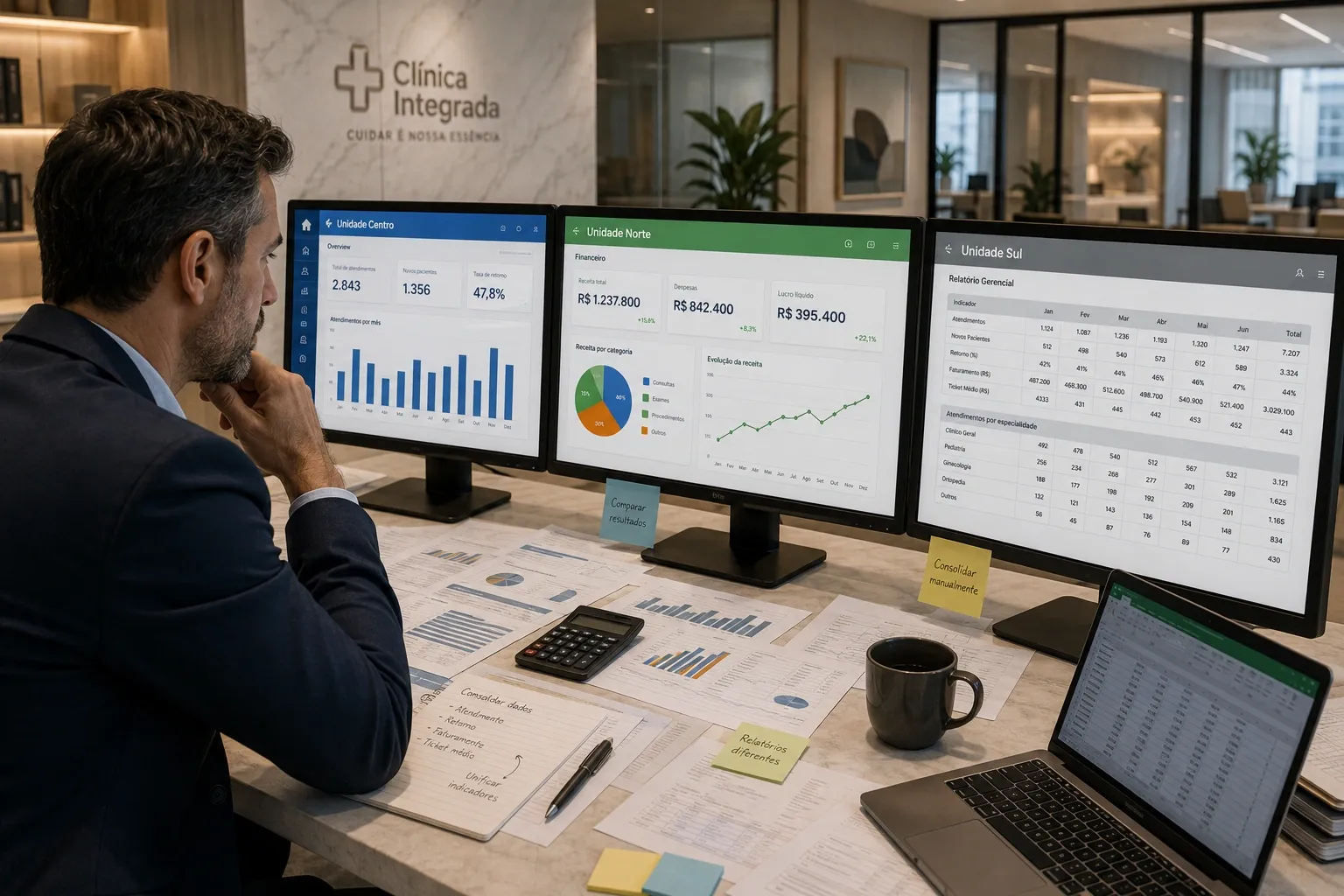
When every location generates separate reports, comparing results requires manual data consolidation.
This increases the time spent on analysis and slows the identification of operational issues and improvement opportunities.
Centralized reporting makes it easier to monitor organizational performance quickly and accurately.
Lack of standardization increases repetitive work
Each location may develop its own processes for patient registration, appointments, billing, and follow-up.
This makes staff training more difficult, increases operational errors, and reduces consistency across the organization.
Standardizing workflows within a single platform helps every team follow the same procedures regardless of location.
How does a single platform improve multi-location healthcare management?
The greatest advantage of managing multiple healthcare locations with one system is centralized information. Administrators can oversee the entire organization without switching between different platforms or manually consolidating data.
An integrated solution typically provides:
- A single patient database
- Centralized appointment scheduling
- Organized patient history
- Management dashboards
- Charts and performance indicators
- Consolidated reports
- Role-based access control
- Standardized workflows
With all information gathered in one place, managers gain greater operational visibility, reduce administrative errors, and make decisions based on up-to-date information.
How does technology help manage multiple healthcare locations?
Technology simplifies multi-location healthcare management by bringing together workflows, information, and performance indicators in a single environment. Instead of managing separate systems or manually consolidating data, administrators gain a centralized view of the entire operation, reducing errors, repetitive work, and time spent on administrative tasks.
Register multiple locations in one environment
Ninsaúde Clinic allows healthcare organizations to register multiple locations within the same platform. Each location maintains its operational structure while administrators oversee the entire network through one integrated system. This simplifies management, supports expansion, and eliminates the need to use different software for each facility.
Role-based access control
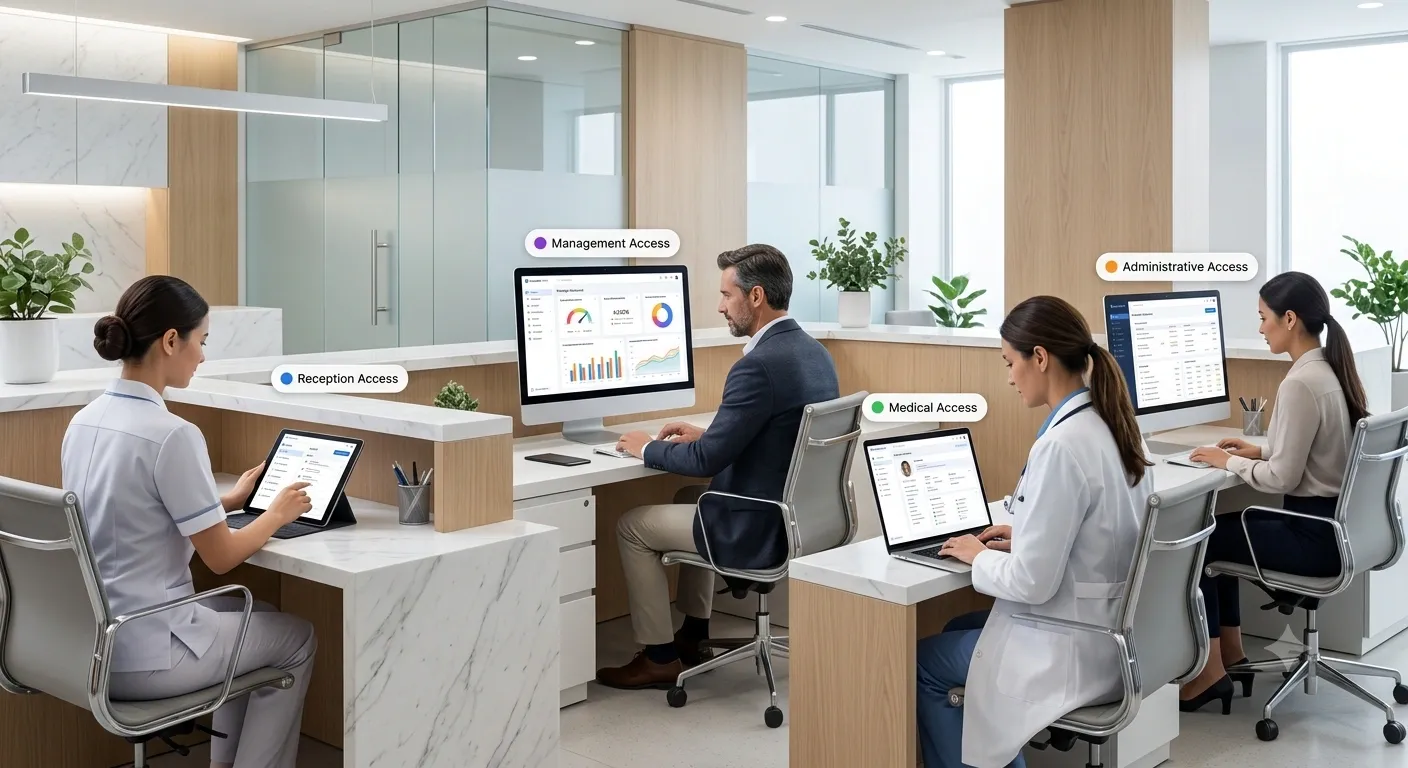
Each user can receive permissions according to their responsibilities and the locations where they work. Receptionists, managers, physicians, and other healthcare professionals only access the information required for their roles. Besides improving data security, this approach creates a more organized workflow and reduces the risk of unauthorized access.
Centralized scheduling across all locations
The system brings together appointment schedules from every location into one environment, allowing administrators to monitor professional availability, distribute appointments more efficiently, and maintain a comprehensive operational view. Centralized scheduling improves planning and maximizes clinical capacity.
Smart electronic health record sharing
Within Ninsaúde Clinic's electronic health record, patient information can be shared through groups configured by the organization itself. Authorized healthcare professionals can access the clinical history required to continue patient care, while access remains controlled according to the clinic's internal policies.
Centralized reports and performance indicators
Ninsaúde Clinic combines reports, charts, and operational indicators in one platform, enabling managers to monitor every location without manually consolidating information. A centralized management view helps identify improvement opportunities, track key performance indicators, and support faster, more informed decisions.

Greater standardization and less repetitive work
By bringing together locations, schedules, electronic health records, and operational indicators in a single system, Ninsaúde Clinic helps standardize processes across the organization. As a result, communication between teams improves, repetitive work decreases, and healthcare organizations gain greater operational consistency as they continue to grow.
What benefits does centralized management offer growing healthcare organizations?
Healthcare organizations that manage multiple locations through a single platform can expand while maintaining greater operational control.
Key benefits include:
- Reduced repetitive work
- Centralized information
- Higher team productivity
- Standardized workflows
- A unified operational view
- Faster decision-making
- Better performance monitoring
- Easier communication between locations
- Continuity of patient care
- Scalability for organizational growth
These advantages create a more predictable operation and help maintain service quality as the number of healthcare locations increases.
Did you find this information helpful?
Keep following our blog for more insights on healthcare management, medical marketing, and healthcare innovation.
Are you a healthcare professional who hasn't explored Ninsaúde Clinic yet? Discover how the platform can streamline your workflows and improve the quality of patient care.
