
Managing multidisciplinary clinics requires much more than basic organization. With different specialties, complex schedules, varied financial flows, and diverse teams, managers must deal daily with both strategic and operational decisions at the same time. This scenario, when not properly structured, quickly leads to overload.
At the same time, many managers fail to realize that the problem is not the number of patients or the growth of the clinic, but rather how the operation is managed. In this article, you will understand the main causes of overload in multidisciplinary clinic management, its impacts, and how to solve it strategically.
What characterizes overload in multidisciplinary clinic management
Manager overload is not only related to an excess of tasks, but mainly to a lack of organization and predictability in operations. In multidisciplinary clinics, where different professionals work with distinct routines, any integration failure leads to rework and an accumulation of decisions.
In practice, this results in managers constantly solving problems, manually monitoring processes, and intervening in tasks that should be automated. The outcome is a reactive routine with no room for strategic planning.

Why multidisciplinary clinics are more difficult to manage
Clinics with multiple specialties naturally have greater complexity. Each medical area has its own particularities, from consultation time to clinical protocols, billing, and patient relationships.
In addition, management must handle multi-professional schedules, different insurance agreements, physician compensation, and varied financial flows. Without integration between these areas, operations become fragmented, making control more difficult and increasing the manager’s dependency to keep everything running.
Main causes of manager overload in the clinic routine
Overload rarely arises from a single factor. It is the result of a combination of structural failures that, together, make management unsustainable over time.
Among the main causes are manual processes, the use of multiple non-integrated tools, communication failures between the team and reception, lack of standardization, and difficulty in financial control. When a clinic grows without organizing these pillars, the manager becomes the central point of all decisions.
Another critical factor is the lack of data visibility. Without clear and updated reports, important decisions are made based on perception, increasing the risk of errors and rework.
Before we move on, one important note: if you manage a healthcare clinic and need better scheduling organization, a secure electronic health record, and centralized financial processes, Ninsaúde Clinic can streamline your daily operations. Get in touch to learn more.

The impacts of overload on operations, revenue, and patient experience
Overload does not affect only the manager. It directly impacts the entire clinic operation. Disorganized processes increase failures, delays, and inconsistencies, harming the care flow.
From a financial perspective, this results in revenue loss, increased claim denials, difficulties in cash flow control, and low predictability. The clinic may have high demand, but it fails to convert it into consistent results.
Regarding patient experience, the effects are seen in delays, communication failures, scheduling difficulties, and a sense of disorganization. Over time, this harms the clinic’s reputation and reduces patient retention.
Signs that your clinic management is reaching its limit
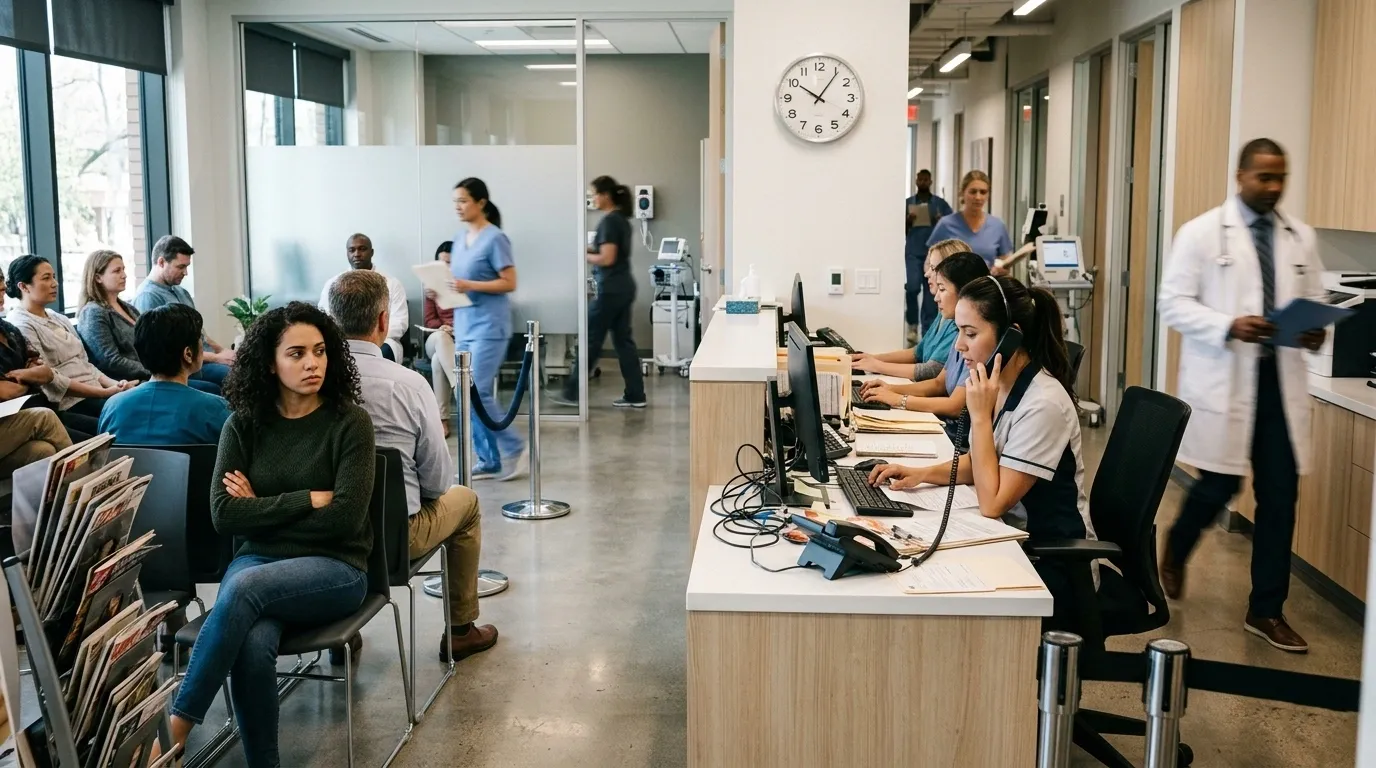
There are clear signs that overload is already impacting management. One of the main indicators is the constant sense of urgency, where everything seems to depend on the manager’s direct intervention.
Other signs include difficulty tracking finances in real time, frequent scheduling issues, an increase in no-shows, internal communication failures, and excessive reliance on spreadsheets.
When the manager cannot step away from operations to think strategically, the clinic enters a stagnation cycle, even when there is growth potential.
How to reduce overload with processes, technology, and standardization
Reducing overload requires a structural change in how the clinic is managed. The first step is to organize processes by defining clear workflows for care, scheduling, billing, and financial management.
Standardization is essential to reduce errors and ensure operational consistency. When everyone follows the same process, dependency on the manager decreases and the team gains more autonomy.
Technology becomes a central element in this process. An integrated management system allows centralizing information, automating tasks, and providing real-time visibility into operations. This reduces rework, improves decision-making, and frees the manager to act more strategically.
The role of integrated management in scaling multidisciplinary clinics with predictability
Clinics that grow sustainably share one common factor: integrated management. When scheduling, electronic health records, and financial systems are connected, operations become more fluid, organized, and predictable.
As a result, the manager shifts from a problem-solver role to a strategic position focused on growth, expansion, and continuous improvement. Predictability enables better planning, resource optimization, and increased efficiency.
If you are looking to reduce overload in your routine and transform your clinic management into a structured and scalable process, exploring solutions like Ninsaúde Clinic can be an important step. With integrated resources and a focus on operational efficiency, it becomes possible to organize the clinic, improve results, and regain control of management.

How Ninsaúde Clinic helps reduce overload in multidisciplinary clinic management
In practice, reducing overload requires more than theoretical organization. It is necessary to rely on tools that support daily operations. In this context, using an integrated system like Ninsaúde Clinic allows centralizing processes, automating tasks, and giving managers more control without increasing their workload.
Among the features that most positively impact management are:
- Integrated multi-professional scheduling
Allows visualization and management of different specialties in a single environment, reducing conflicts, rework, and dependency on reception. - Automated appointment confirmations
Sends reminders via WhatsApp or SMS, helping reduce no-shows and minimizing the need for manual intervention. - Customizable electronic health record (EHR)
Organizes all clinical information in one place, with adaptable protocols by specialty, improving care and continuity. - Complete and integrated financial management
Cash flow control, physician compensation, bank reconciliation, and strategic reports that provide a clear view of the clinic’s financial health. - Ninsaúde Pay* for prepayments or point-of-care payments
Improves cash flow and reduces delinquency, increasing financial predictability. - CRM for patient relationship and retention
Enables patient reactivation, campaign organization, and increased return from the existing patient base.
*Ninsaúde Pay may not be available in some versions. Check feature availability in your country.

Systems with open API: how integration between tools reduces management overload
As the clinic grows, using multiple tools becomes inevitable. Without integration, rework, data duplication, and time loss arise. Systems with an open API allow connecting different solutions and automating information flow, reducing the operational burden on the team.
In practice, this enables integration between the management system and BI platforms, financial tools, marketing platforms, and other systems used by the clinic. With real-time synchronized data, managers gain more control, reduce errors, and make more confident decisions.
In the case of Ninsaúde Clinic, the open API allows the system to adapt to the clinic’s reality without requiring a complete change in its existing structure. This ensures scalability, organization, and predictability, preventing growth from increasing management overload.
Did you find this information helpful?
Keep following our blog for more content on management, medical marketing, and innovation in healthcare.
Are you a healthcare professional and still unfamiliar with Ninsaúde Clinic? Discover how the platform can optimize processes and elevate the quality of patient care.
