

CEO of Ninsaúde and 224Scan attended the conference and shares details about his immersion in discussions surrounding digital health and Artificial Intelligence.
Healthcare digital transformation is happening simultaneously in different parts of the world. While some countries are advancing in Artificial Intelligence and interoperability, others still face basic challenges related to access, infrastructure, and operational organization.
Between April 15 and 17, 2026, Helton Marinho, CEO of Ninsaúde, attended the Digital Health Conference in Mozambique. More than simply attending lectures, the experience allowed him to closely understand local healthcare challenges, technological advances, and the growing impact of Artificial Intelligence in medicine. In this article, you will discover the main insights from this immersion and how they connect to the future of digital healthcare.
Before we move on, one important note: if you manage a healthcare clinic and need better scheduling organization, a secure electronic health record, and centralized financial processes, Ninsaúde Clinic can streamline your daily operations. Get in touch to learn more.

What stood out in Mozambique
During the first few days, it became clear that many healthcare challenges in Mozambique also exist in other parts of the world, including Brazil. Long waiting lines, manual processes, difficulty accessing specialists, and operational overload are still part of many institutions’ daily routine.
At the same time, the country is experiencing a strong digital transformation movement.
One of the most discussed topics was the use of AI to improve efficiency and accelerate clinical processes.
Digital health in Africa: a growing landscape
Many people still associate healthcare innovation only with Europe, North America, or Asia. However, the conference showed that digital transformation is also growing rapidly across Africa.
Discussions highlighted initiatives focused on:
- hospital modernization;
- strategic data usage;
- system integration;
- process automation;
- diagnostic support.
Several moments made it clear that some African countries are accelerating digitalization without repeating challenges faced by older markets. This brings an important lesson for Brazilian healthcare managers: innovation is not only about budget. It depends on strategy and adaptability.
One example is Ethiopia. After implementing teleradiology within its healthcare system, TAT (Turnaround Time between exam completion and final report delivery) decreased significantly, increasing public satisfaction by 17.7%.
Artificial Intelligence is already part of healthcare
For years, AI in healthcare seemed distant. Today, it is already being used for:
- diagnostic support;
- data analysis;
- operational automation;
- triage;
- bottleneck reduction.
During the conference, it became clear that many countries now see Artificial Intelligence as an operational necessity, not just a trend.
This movement directly connects to Ninsaúde’s vision for the future of digital healthcare.
224Scan: AI applied to medical imaging diagnostics
Much of the conference discussions reinforced the need for solutions capable of reducing operational time and increasing clinical efficiency.
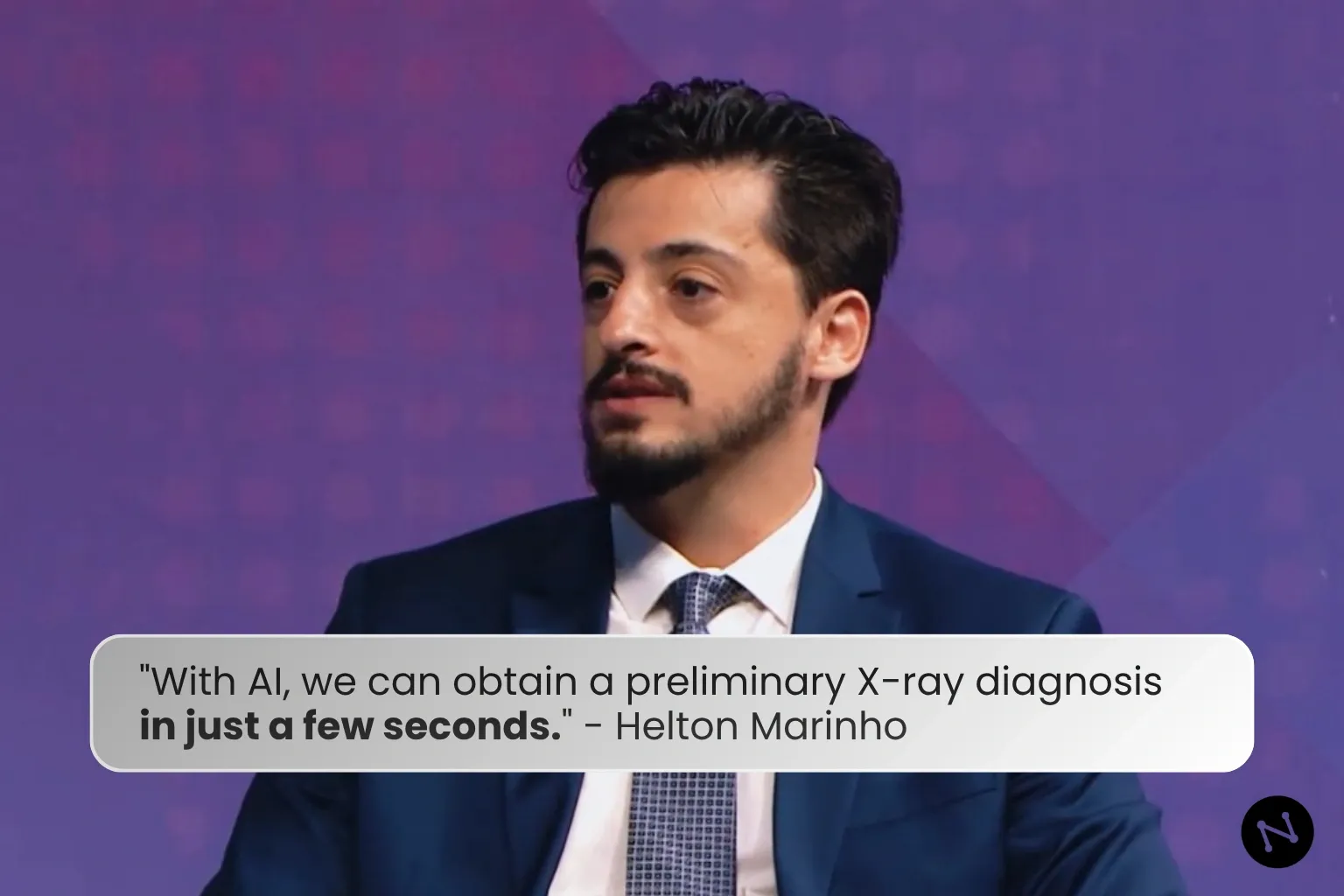
That is exactly why 224Scan was created: an Artificial Intelligence solution developed for automated and intelligent medical imaging interpretation. Thanks to its advanced technology, the platform can deliver preliminary X-ray reports within seconds.
According to Helton: “We can analyze images remotely [...] and prepare a preliminary analysis that supports both the radiologist responsible for the exam and the healthcare team treating the patient locally.”
During the conference, Helton also spoke with TV Grande, from Televisão de Moçambique, about the challenges of AI adoption in healthcare, its advances, and future perspectives for the industry.
Watch the full interview here:
Interview with Helton for TV Grande, a channel on Televisão de Moçambique.
Maria: Ninsaúde’s vision for AI in healthcare management
Artificial Intelligence is also beginning to transform healthcare management. Following this vision, Ninsaúde is developing Maria, an AI-powered virtual assistant integrated into the platform ecosystem.
The goal is not to replace professionals. The proposal is to reduce operational workload, automate tasks, and improve clinical routine efficiency.
During the conference, it became clear that this demand is global.
Regardless of the country, clinics and hospitals face:
- excessive tasks;
- administrative overload;
- operational difficulties;
- time loss caused by repetitive processes.
The trend is for AI to increasingly act as a strategic support tool for teams and healthcare managers.
What Brazilian healthcare managers can learn from this experience
The conference showed that many healthcare challenges are universal. Problems involving management, productivity, integration, and operational organization appear in different countries.
At the same time, it also became evident that technology alone does not solve everything. Tools need to be connected to strategy, processes, and each institution’s operational reality.
For healthcare managers, the main takeaway is clear: digital transformation is no longer a competitive advantage. Today, it is part of healthcare operational sustainability.
The future of healthcare will be more connected and intelligent
Participating in the Digital Health Conference in Mozambique reinforced an important vision for Ninsaúde: technology must generate real impact in institutions’ daily operations.
In the end, innovation is not just about modernization. It is about:
- reducing bottlenecks;
- improving decision-making;
- increasing efficiency;
- creating predictability;
- allowing healthcare professionals to focus more on patients.
Enjoyed these insights?
Keep following our blog for more content on clinic management, medical marketing, and healthcare innovation.
Are you a healthcare professional who hasn’t tried Ninsaúde Clinic yet? Discover how the platform can streamline processes and elevate the quality of patient care.
