
The question of cloud security in medical software has stopped being merely “technical” and has become a management decision. Clinics and practices handle sensitive data (medical records, images, prescriptions, reports, financial information, and payer/insurance details), and any failure can create clinical, reputational, and legal impact.
At the same time, the cloud has become the modernization standard: it enables remote access, integration across locations, continuous updates, and scalability. The key is to understand that the cloud is not automatically secure or insecure—security is a set of well-defined controls, responsibilities, and processes. In this article, we will cover Is Cloud-Based Medical Software Secure?
What “being in the cloud” means in practice
When medical software is “in the cloud,” the system and data are hosted on managed infrastructure (data centers and cloud services). Access happens over the internet, typically via a browser or app, with user authentication.
For leaders and managers, the most important detail is this: the cloud changes where and how data is stored and protected, but it does not eliminate the need for governance and internal controls. In other words, it is not enough to choose a “cloud” system; you must evaluate the security model and the shared responsibility boundaries.

Most common models
- SaaS (Software as a Service): you use a ready-to-run system, and the vendor handles infrastructure, updates, and much of the security.
- Dedicated/private hosting: exclusive infrastructure with more control—and usually more cost and complexity.
- Hybrid: part of the workflow/integrations on local systems and part in the cloud.
A SaaS solution like Ninsaúde Clinic is often the most efficient path—as long as there are clear controls over access, auditing, encryption, backups, and regulatory compliance.
Cloud security: what changes (and what does not)
A common misconception is that, because it is in the cloud, “someone takes care of everything.” In practice, there is a shared responsibility model:
- The vendor tends to protect the infrastructure, availability, and environment hardening.
- The clinic must ensure proper user provisioning, permissions, conduct, passwords, internal routines, and operational compliance.
This means that typical incidents in clinics do not happen because of “highly sophisticated hackers,” but because of simple failures:
- users sharing credentials;
- overly broad permissions (everyone can see everything);
- missing audit trails;
- no process to revoke access when staff leave;
- personal devices without minimum protection.

Main risks—and how managers should look at them
To decide safely, it helps to separate risks into three classic dimensions: confidentiality, integrity, and availability.
Confidentiality: who can access what?
The risk here is data leakage or unauthorized access to patient information. In practice, you reduce this with:
- role-based profiles and permissions (front desk should not have the same access as clinicians);
- strong authentication (ideally with MFA);
- segmentation by site/location when applicable;
- access management for third parties (accounting, IT, partners).
A realistic example: a clinic with rotating teams may need to grant temporary access to the medical record, but only what is necessary for a shift. If the system supports granular roles and time-limited access, you reduce risk without slowing operations.
Integrity: is the data trustworthy and traceable?
Integrity means ensuring that the medical record is not altered without a record, or that prescriptions are not manipulated. Look for:
- audit logs and traceability (who did what, when, and from where);
- change trails in clinical documents;
- digital/electronic signatures for consents, forms, and prescriptions when applicable;
- versioning and clinical history.
Management tip: auditing is not “only for regulators.” It helps resolve disputes, improve clinical quality, and reduce legal exposure.
Availability: the system must stay up
In healthcare, downtime turns into queues, lost schedules, delays, and front-desk stress. The cloud can be an advantage here (redundancy, scalability), but you still need to require:
- backups with a defined frequency;
- a continuity plan (DR/BCP) and estimated recovery time;
- monitoring and support with an SLA;
- the ability to operate with contingency (e.g., exports, reports, and minimal critical routines).
Before we move on, one important note: if you manage a healthcare clinic and need better scheduling organization, a secure electronic health record, and centralized financial processes, Ninsaúde Clinic can streamline your daily operations. Get in touch to learn more.

Technical controls you should look for (and demand)
Not every manager needs to master technical jargon, but it is essential to know which controls truly matter and how to verify them in contracts, documentation, and vendor demonstrations.
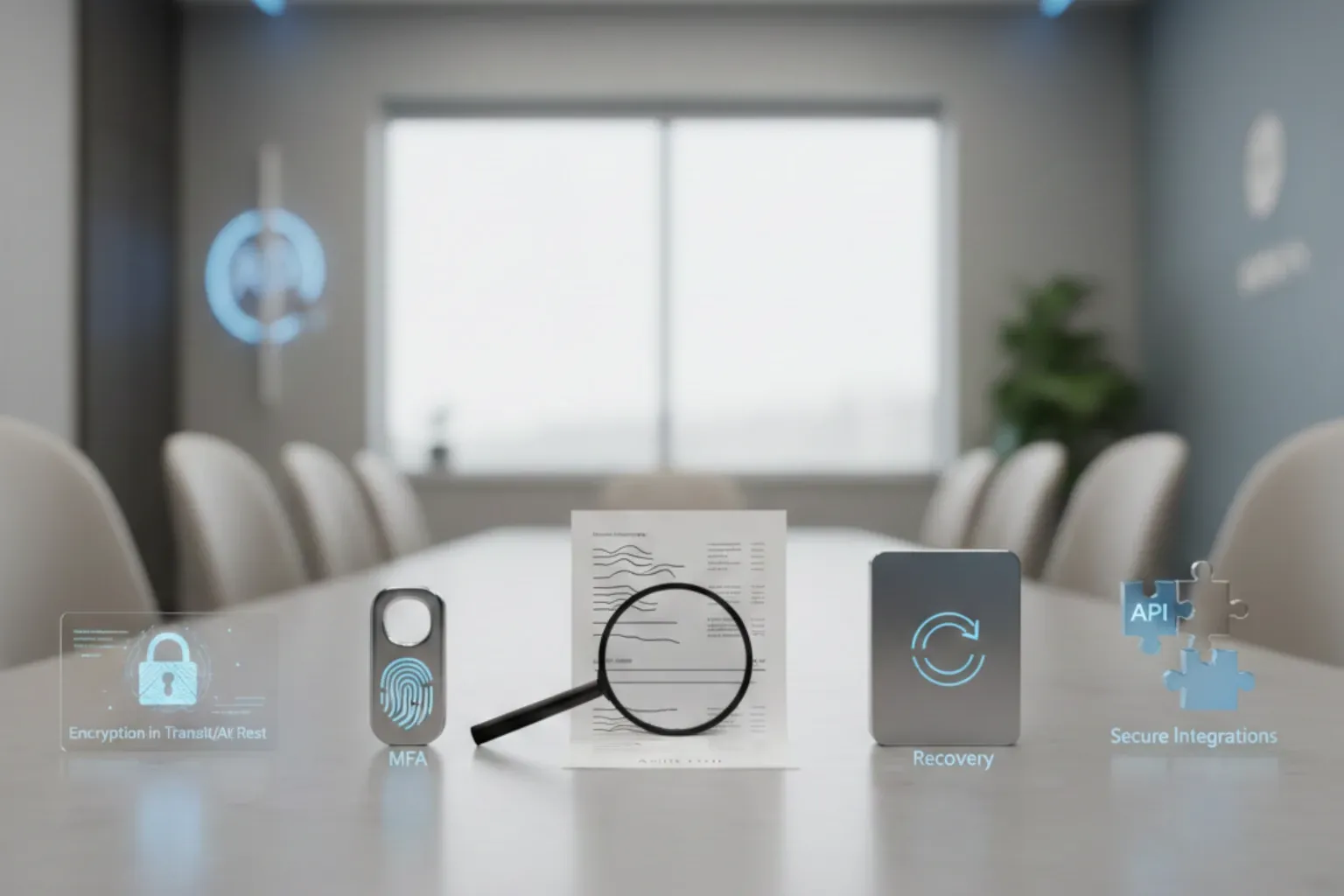
Essential technical checklist
- Encryption
- in transit (data moving) and at rest (data stored);
- watch out for “half encryption” (only HTTPS on login, but weak protection at the database/storage layer).
- Identity and access management (IAM)
- detailed roles and permissions;
- multifactor authentication (when available);
- password policy and lockout after repeated attempts.
- Auditing and traceability
- access and change logs;
- reports for internal investigations.
- Backups and recovery
- defined cadence;
- restoration tests (it is not enough to “have backups”; you must prove you can restore).
- Integration security (APIs)
- keys, tokens, expiration, and scope;
- call logging and rate limits to prevent abuse.
- Updates and fixes
- patching policy;
- communication of relevant changes.
If you use Ninsaúde Clinic, you can feel confident: it is a secure solution and it already includes the essential pillars of protection and traceability, such as end-to-end encryption, role- and permission-based access, and audit logs, ensuring control over who can access what and recording actions performed within the system.
Process controls: the “human factor” is the weakest link
Even with excellent technology, clinics can be exposed by operational gaps. This is where simple decisions make a big difference.
Routines that reduce risk quickly
- Account policy: no credential sharing; each user has their own login.
- Joiner/Mover/Leaver process: grant and revoke access on the same day staff start/leave.
- Least privilege: provide only the access needed for the role.
- Periodic access reviews: monthly or quarterly, especially in clinics with high turnover.
- Short, recurring training: phishing, WhatsApp use, document sharing, and front-desk privacy posture.
Practical example: the front desk often sends exam PDFs through informal channels. Standardizing where and how attachments are shared (and avoiding sensitive data in group chats) reduces exposure without major investment.

Data protection in healthcare: the cloud is neither an excuse nor a villain
Data protection laws do not ban the cloud. They require a lawful basis, purpose limitation, security, transparency, and governance. For clinics, the central point is understanding roles:
- the clinic is typically the data controller (defines purpose and means);
- the software vendor is the data processor (processes data on the clinic’s behalf);
- there may be sub-processors (infrastructure, messaging, etc.).
What to review in contracts and documents
- confidentiality and security clauses;
- where and how data is stored;
- data retention and deletion (what happens when the contract ends);
- incident reporting and timelines;
- support for data subject requests (access, correction, deletion when applicable).
For managers, a strong signal is when the vendor states adherence to recognized best practices and regulations and describes security and audit controls objectively.
Essential security criteria for cloud-based medical software
In practice, security is evaluated with evidence. Ask direct questions and request demonstrations.
Questions worth more than any slogan
- What encryption is used (in transit and at rest)?
- Are there detailed roles/permissions? Can access be limited by function and location?
- Are there audit logs for access and changes? How long are they retained?
- How are backups handled and restoration tests performed?
- What is the availability and support SLA?
- How does incident response and customer communication work?
- Does the system support digital/electronic signatures and consent records?
- For integrations, is there an API with secure authentication and scope control?
These points help reduce operational risk and support day-to-day compliance.
Day-to-day scenarios where the cloud tends to be safer
In many clinics, the cloud is safer than a local server “forgotten” in a room, unpatched and unmonitored. Some scenarios where the cloud usually wins:
- multi-location clinics (central control and location-based permissions);
- multidisciplinary teams (controlled sharing of the medical record);
- telemedicine and digital workflows (centralized consent, prescribing, and attachments);
- fast growth (scalability without improvised infrastructure).
A practical best practice is integrating telemedicine into the medical record with proper logging and traceability, reducing data scattered across isolated apps.
Cloud security: trust built, not promised
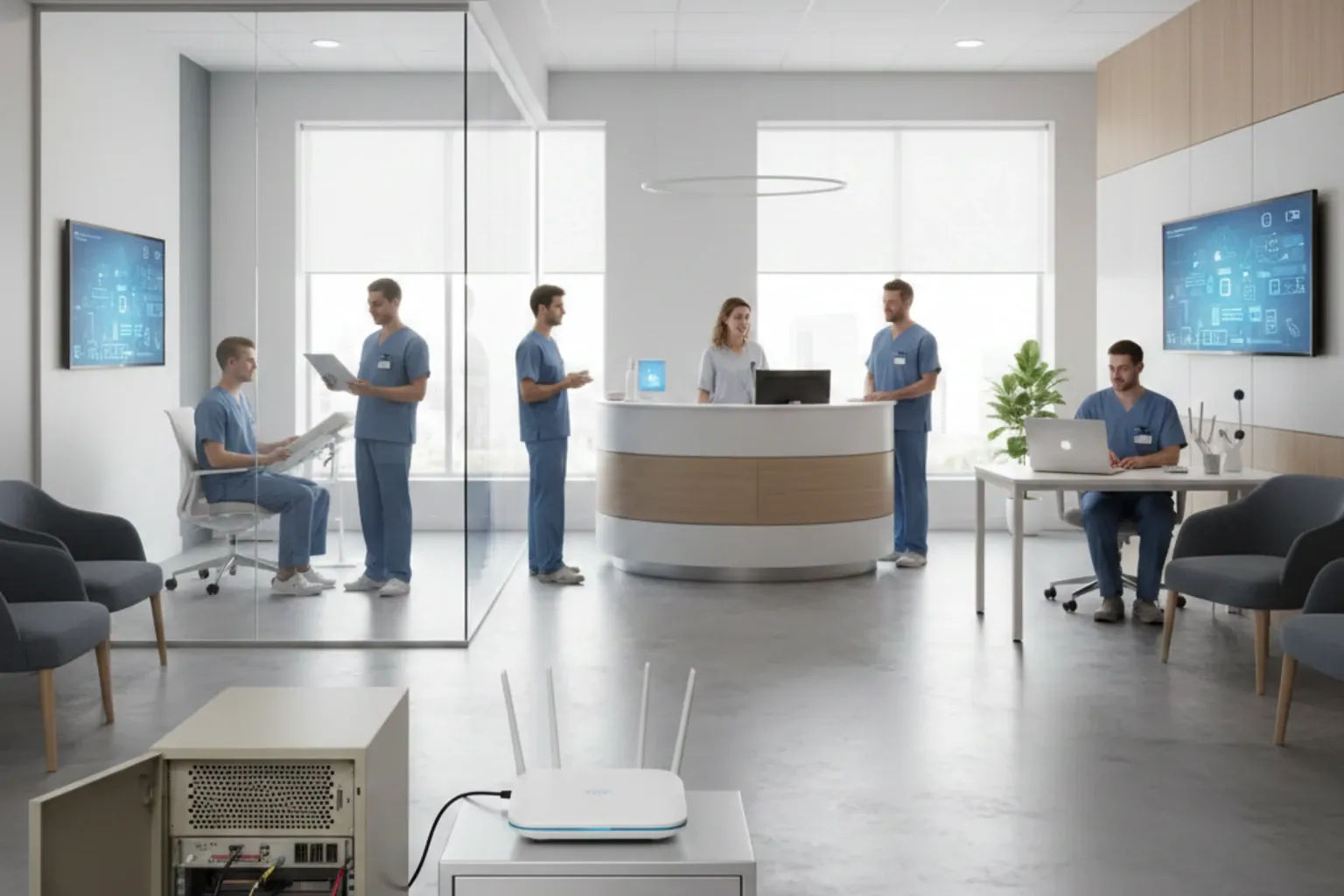
Cloud-based medical software can be secure—and it often is—when you combine the right technology, well-defined contracts, and disciplined internal routines. For managers, the focus is not choosing “cloud or on-prem,” but operating with an ecosystem that delivers access control, traceability, continuity, and compliance, supported by day-to-day governance.
The decision becomes simpler when security turns into an objective criterion and an operational habit—and by choosing a platform like Ninsaúde Clinic, which already includes these pillars (such as role- and permission-based access, encryption, and auditing), the clinic gains efficiency without compromising patient protection.
Enjoyed these insights?
Keep following our blog for more content on clinic management, medical marketing, and healthcare innovation.
Are you a healthcare professional who hasn’t tried Ninsaúde Clinic yet? Discover how the platform can streamline processes and elevate the quality of patient care.
