

Organizing processes in a clinic is not bureaucracy: it’s about creating predictability to reduce noise, keep the team productive, and deliver a more consistent patient experience. When the flow is clear, delays, rework, communication failures, and financial losses decrease — and managers can make decisions based on data rather than urgencies.
Organization happens in layers: understanding the current flow, standardizing routines, defining responsibilities, integrating information, and monitoring indicators. The goal is to simplify, making each step “routine-proof,” so outcomes don’t depend on extra effort or specific individuals. In this article, we will cover How to Organize a Clinic’s Processes
See the clinic as a set of workflows
A process is any sequence of steps that transforms a demand into a result. In clinics, this happens constantly, so the first step is to separate clinical from operational work — and connect both.
Clinical workflow (the patient journey)
Map the journey into simple stages, which may vary by specialty but usually follow:
- scheduling and guidance
- arrival and check-in
- care delivery and clinical documentation
- closing the visit (care plan, prescriptions, tests)
- payment/billing
- post-visit follow-up and return visits

Operational workflow (back office)
The administrative journey supports care. The most relevant processes typically include:
- scheduling rules, add-ons, and blocks
- registration and documentation
- accounts payable/receivable and reconciliation
- provider payouts and commissions
- insurance billing (forms, deadlines, pending items)
- access management and data security
Organizing means ensuring both journeys fit together without improvised “shortcuts.”
Before we move on, one important note: if you manage a healthcare clinic and need better scheduling organization, a secure electronic health record, and centralized financial processes, Ninsaúde Clinic can streamline your daily operations. Get in touch to learn more.

Run an objective assessment of the current state
Before changing anything, map what already happens as it truly happens. This prevents solutions that sound good but don’t address root causes.
How to map without overcomplicating
Pick 3 to 5 critical processes (e.g., scheduling, front desk, visits, finance, insurance billing) and record:
- real steps (actual step-by-step)
- owners for each step
- tools used (systems, spreadsheets, paper)
- error/rework points
- average times (wait time, visit duration, close-out)
A table with “step / owner / time / risk / notes” is usually enough to reveal bottlenecks.
Most common bottlenecks
Some signals show exactly where to prioritize:
- no-shows and cancellations above expectations
- recurring delays during peak hours
- incomplete registrations and front-desk rework
- inconsistent charts or scattered attachments
- finances that often don’t “balance”
- recurring denials and pending items in insurance billing
The goal of the assessment is to prioritize what yields the highest return with the least complexity.
Standardize routines with simple procedures
Standardization reduces variation and increases predictability. It doesn’t need to be a long manual: short, day-to-day procedures work better.
What to standardize first
Start with what repeats and impacts patients and revenue:
- scheduling, confirmations, and cancellation policies
- check-in, data updates, and required documentation
- visit preparation (triage, instructions)
- minimum required clinical documentation
- collections, receipts/invoices, and payouts
- insurance workflow (checklists and deadlines)
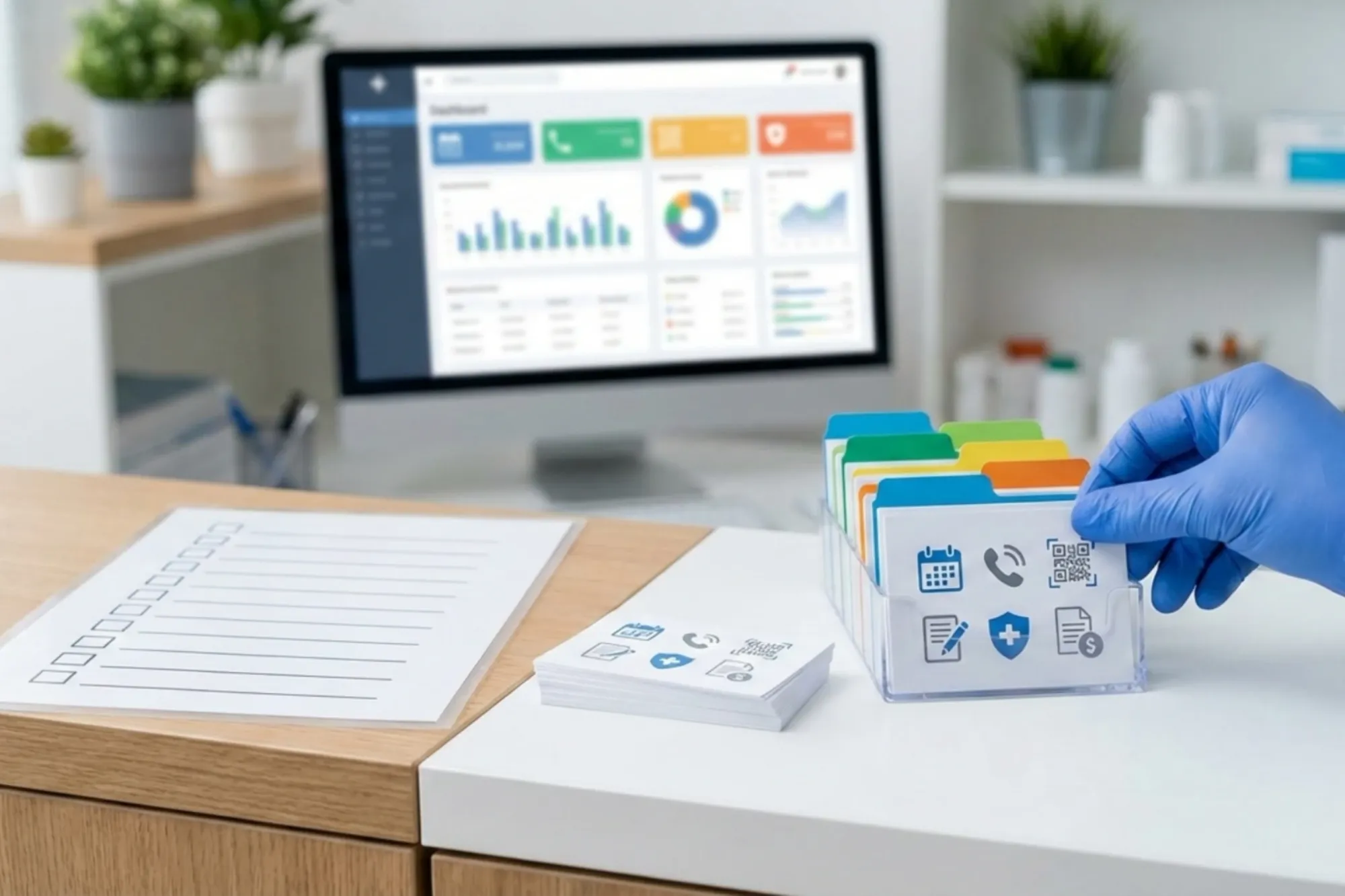
Minimum structure for a procedure
To be executable, each procedure should include:
- purpose (what it ensures)
- step-by-step (no ambiguity)
- owner and backup
- quality checklist (how to verify)
- deadlines and exceptions (what to do outside the standard)
This reduces dependency on key individuals and supports training.
Organize scheduling and the front desk to remove friction
The schedule is the core of operations. If it’s disorganized, the domino effect shows up as delays, overload, and dissatisfaction.
Essential scheduling rules
Define and document clear rules:
- standard times by visit type
- limits for add-ons per time block
- blocks for breaks and admin tasks
- confirmation criteria (timing and channels)
- insurance-specific rules (documents and limits)
When rules are clear, the front desk stops renegotiating exceptions all day.
Check-in and confirmation as routine
Organization improves when patients arrive with updated information and when confirmations are consistent. Standardize:
- what must be confirmed beforehand (data, documents, authorization)
- what must be collected at check-in
- what to do in case of late arrivals, no-shows, and reschedules
This reduces rework and stabilizes the daily flow.
Structure care delivery with consistent clinical documentation
A well-organized clinical process depends on well-recorded information. Beyond supporting continuity of care, it improves safety and reduces audit risk.
Minimum charting standard
Define a documentation standard with required fields and attachment organization:
- essential demographics and chief complaint
- assessment/progress and care plan
- prescriptions and test orders
- categorized attachments (labs, images, documents)
Whenever possible, use specialty templates and avoid fully “free-form” notes without structure.

Consents and signatures
Clinical documents and consents require traceability. Standardize:
- when consent is mandatory
- where the document is stored
- who can access and edit it
This strengthens governance and reduces misplacement.
Close the financial loop with routines and controls
Without a financial process, the clinic becomes reactive. Organizing means creating short, frequent, verifiable routines.
Essential finance routine
Implement a minimum operating cadence:
- daily posting of collections
- accounts payable logged by due date
- cost-center categorization
- payout/commission checks based on rules
- monitoring actual vs. projected cash flow
What isn’t recorded consistently becomes an error at month-end.
Insurance billing: checklists and deadlines
Insurance requires discipline. Organize with:
- documentation checklist by payer
- standardized forms and codes
- a submission and response calendar
- tracking of pending items and denials (reason and correction)
With a stable process, collection cycles shorten and predictability increases.
Ensure post-visit follow-up and returns are part of the process
Care doesn’t end when the patient leaves. Without organized follow-up, continuity drops and return rates fall.
Patient relationship routines
Define simple, recurring triggers:
- scheduled return visits by specialty
- follow-up on pending test results
- reactivation of inactive patients
- educational communications (when applicable)
The key is to have a rule, an owner, and a record of the action.
Sustain organization with indicators and governance
Processes only last with monitoring. Without it, the clinic returns to improvisation.
Essential indicators
Choose a few indicators that are easy to measure and useful:
- no-show and cancellation rate
- average wait time and delays
- schedule utilization
- average ticket and payment mix
- insurance collection cycle time
- return rate (by period)
Brief monthly reviews are usually enough to correct course.
Data protection as part of the process
Include security controls within the workflow:
- role-based access and permissions
- audit logs and traceability
- sharing and storage rules
- backup and continuity routine
This reduces risk and increases trust.
Manage change clearly
Organizing processes depends on team adoption. To increase adherence, implement in phases and keep complexity low.
Lean implementation plan
A practical playbook is:
- map and prioritize critical processes
- standardize with procedures and checklists
- train, apply, and adjust with feedback
- monitor indicators and reinforce routines
Training as a routine
Set a maintenance standard:
- onboarding for new hires
- short periodic refreshers
- a responsible owner for each process (workflow owner)
This way, organization doesn’t rely on “institutional memory.”

Organization that frees up time to deliver better care
When a clinic organizes its processes, it reduces internal friction and increases the quality perceived by patients. The benefit is not only operational: it improves safety, strengthens governance, and builds a foundation for sustainable growth.
With an objective assessment, simple standardization, clear financial routines, and indicator-driven monitoring, operations stop being hostage to constant urgency. The result is a more predictable, efficient clinic, ready to evolve without losing quality.
Enjoyed these insights?
Keep following our blog for more content on clinic management, medical marketing, and healthcare innovation.
Are you a healthcare professional who hasn’t tried Ninsaúde Clinic yet? Discover how the platform can streamline processes and elevate the quality of patient care.
