
In Peru, choosing medical software is no longer just a tech decision. It has become a management decision. With packed schedules, lean teams, more demanding patients, and constant pressure to stay organized, doctors and clinic managers look for a system that reduces rework, increases predictability, and brings control to daily operations.
The core idea is simple: the best software is not the one that promises everything, but the one that improves the routine in real life. In this article, you will understand how doctors in Peru choose the best software, which criteria truly matter, which essential search terms and keywords should appear in content on this topic, and how Ninsaúde Clinic serves as an example of an effective management system to improve internal clinic processes.
When a practice grows, software becomes the operational center
Early on, many practices can function with spreadsheets, messages, and manual controls. But growth comes with a cost: more patients, more follow-ups, more add-ons, more confirmations, more payments, and higher risk of mistakes.
When that happens, software stops being a “helper” and becomes the system that keeps the operation running. Doctors and clinic managers start looking for a clinic management system in Peru that centralizes:
- scheduling and confirmations
- electronic health records and documents
- finance, cash flow, and reporting
- administrative routines and standardization
- indicators for decision-making
Ninsaúde Clinic is an example of a platform that integrates these pillars and helps improve internal processes without forcing the team to rely on separate controls.
Before we move on, one important note: if you manage a healthcare clinic and need better scheduling organization, a secure electronic health record, and centralized financial processes, Ninsaúde Clinic can streamline your daily operations. Get in touch to learn more.

7 criteria that define the best clinic software in Peru
Below are the most important criteria doctors and clinic managers consider when evaluating medical software in Peru.
1) An electronic health record that makes visits flow
An electronic health record system must be fast, intuitive, and adaptable. If the EHR slows the visit down, the team will abandon it. Look for customizable forms, specialty templates, calculated fields, attachments, signing options, and easy access across devices.
Ninsaúde Clinic is an example because it allows customization of forms and protocols, making documentation more productive and aligned with real clinical workflows.
2) Scheduling that reduces no-shows and creates predictability
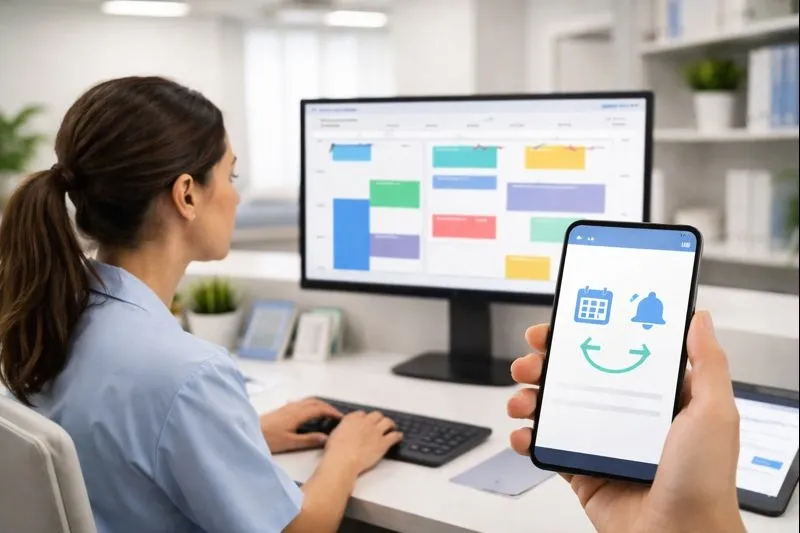
Scheduling is not just a calendar. It controls demand. A good online scheduling system reduces no-shows, organizes follow-ups, and reduces front-desk overload. That is why appointment confirmations and automated reminders are decisive, along with smart blocks, add-ons, per-provider calendars, and follow-up scheduling.
When scheduling is connected to the rest of the system, the impact is clear: fewer gaps and fewer front-desk bottlenecks.
3) Financial management with real visibility and control
Many tools record payments, but few deliver true financial management for clinics. What matters to managers is visibility into cash flow, recurring entries, reporting, forecasting, and clarity about what came in, what is pending, and what is overdue.
Ninsaúde Clinic is an example of a system with a robust finance module designed to bring predictability and structure, connecting operations to financial control.
4) Implementation and migration that do not disrupt the clinic
A major fear when switching systems is operational downtime or data loss. That is why doctors and managers value guided implementation, a reliable migration process, and feature-based training. Good software fits into the workflow without forcing the team to rebuild processes from scratch.
Here, the advantage is not only the product, but the implementation method and support during the transition.
5) Patient data security and access control
Patient data security is non-negotiable. The system should offer encryption, role-based access, audit trails, and solid practices for protecting clinical information.
In practical terms, this means knowing who accessed what and when, and ensuring sensitive data is not exposed due to weak processes.

6) Integrations and an API so the clinic is not an island
No clinic wants to be trapped in a tool that becomes a silo. Integrations with other systems are important, whether for BI, administrative tools, communication platforms, or other solutions the team already uses.
That is why an integration API is a strong differentiator. Ninsaúde Clinic has an open API, which makes it easier to build a connected ecosystem and reduce rework.
7) Management reports and indicators for faster decisions
Without management reports and clinic performance indicators, leadership becomes reactive. With indicators, the clinic can anticipate bottlenecks. The best platforms help managers see: no-shows, productivity, schedule utilization, revenue, collections, most requested services, and process friction points.
A mature choice is one that turns data into simple, frequent decisions, without forcing the team to live in spreadsheets.

How to evaluate software in a practical way
Instead of comparing feature lists, doctors and managers in Peru often make a smarter move: they test the software using the real practice workflow.
A simple evaluation route:
- A patient schedules (or the front desk schedules)
- The system confirms and sends automated reminders
- The patient checks in and the front desk gains time
- The doctor documents quickly in the EHR
- The finance flow records payments and keeps cash organized
- Follow-ups are scheduled with predictability
- The manager reviews reports and indicators
If the system cannot support this end-to-end cycle, it becomes just another tool to manage instead of reducing work.
The Uronor clinic case: stability and organized routine since 2016
A strong sign of a good choice is continuity. The Uronor clinic has used Ninsaúde Clinic since 2016 and still runs its operations on the system today, currently with 2 healthcare professionals delivering care.
This kind of case highlights something many overlook: the best software is not only the one that looks great in a demo, but the one that keeps working daily with consistency, adapting to workflow changes and maintaining organization over time.
For smaller clinics and growing practices, Uronor’s experience points to a practical decision: choosing a medical practice management system that delivers organization without bureaucratizing care.
Questions that speed up decisions and prevent buying mistakes
Before committing, doctors and managers usually ask direct questions. Use these to guide your evaluation:
- Is the electronic health record customizable by specialty, or rigid?
- Does scheduling include appointment confirmations and automated reminders?
- Does the system reduce no-shows in a practical way?
- Does financial management include reports and forecasting, or just entries?
- Does the platform offer integrations with other systems and an integration API?
- How does implementation and data migration work?
- Is support responsive and problem-solving, without red tape?
- Are management reports and performance indicators easy to use?
When these answers are strong, the choice stops being a guess and becomes an investment.
What to watch in a demo to avoid traps
Demos can be polished, but real use is what matters. During testing, watch for:
- EHR speed during an actual visit
- ease of scheduling follow-ups and managing calendars
- how the system handles cancellations, add-ons, and rescheduling
- whether finance is truly integrated with care delivery
- whether management reports actually support decisions
- whether access control and audit trails are available
- whether integrations and the integration API are real, not just promises
In this context, Ninsaúde Clinic is often referenced as a benchmark for connecting clinical operations and management, offering clinic process automation and managerial visibility with less improvisation.
Enjoyed these insights?
Keep following our blog for more content on clinic management, medical marketing, and healthcare innovation.
Are you a healthcare professional who hasn’t tried Ninsaúde Clinic yet? Discover how the platform can streamline processes and elevate the quality of patient care.
