

In the United States, clinical management software is not just a support tool: it sets the pace of operations, directly influences billing, patient experience, and the legal security of the institution. In a scenario with strong presence of insurers, strict rules for data protection, and high pressure for efficiency, a poor choice can result in denials, constant rework, and a frustrated team.
That’s why system selection usually follows a structured process, with clear technical and business criteria. Rather than looking for “the most complete software on the market,” U.S. clinics look for the solution that most precisely fits their care, financial, and organizational model. In this article, we will discuss how clinics in the United States choose the best software.
Security and Regulatory Compliance as a Mandatory Filter
In the United States, the question is not “if” the software is secure, but “how well” it handles privacy and regulatory compliance. Regulations such as HIPAA set strict standards for the use and storage of health data, and clinics know that any incident can lead to fines and lawsuits.
In practice, managers check whether the system:
Implements encryption of data in transit and at rest.
Provides detailed access control, with profiles and permissions by role.
Logs access and changes in medical records and documents.
Maintains clear backup, recovery, and business continuity policies.
Includes contracts and policies compatible with data protection laws.

Patient Journey: From Scheduling to Post-Visit
After the security filter, U.S. clinics analyze how the software affects the patient journey. The logic is simple: if the system makes the patient’s life harder, the clinic’s reputation suffers.
Features that are evaluated closely:
Online appointment scheduling, allowing patients to choose provider, location, and type of visit.
Automated reminders to reduce no-shows and last-minute rescheduling.
Digital check-in, with forms, consents, and data completed before arrival.
Integrated telemedicine, instead of parallel solutions disconnected from the medical record.
Simple sending of prescriptions, certificates, and instructions after the visit.
Billing, Insurance, and Financial Health
In the United States, the relationship with insurers and public programs is complex; billing requires precision in codes, eligibility rules, and deadlines. For this reason, clinics treat the financial and billing module as a central piece in software selection.
Among the key points analyzed:
Ease of correctly recording procedures and codes required by payers.
Support for managing authorizations, eligibility, and reduction of denials.
Production reports by provider, insurer, location, and period.
Clear view of expected revenue, collected amounts, and write-offs.
Tools for managing delinquency and analyzing reasons for rejection.
Systems that integrate clinical and financial workflows—such as Ninsaúde Clinic, with accounts payable and receivable modules, cash flow, and provider payouts—help turn billing into a predictable, data-driven process, rather than a “last-minute race” at the end of the month.
Interoperability: The Software Must Talk to the Ecosystem
The U.S. healthcare ecosystem is highly connected. Clinics exchange data with laboratories, imaging centers, hospitals, pharmacies, e-signature platforms, and financial systems. An isolated software solution quickly becomes a bottleneck.
That’s why managers assess:
Whether the system offers open, well-documented APIs.
Whether there are ready-made integrations with labs, radiology, ERPs, CRMs, and BI tools.
Whether the integration model is sustainable (costs, limits, technical support).
Whether the system architecture can keep up with future interoperability requirements.
Before we move on, one important note: if you manage a healthcare clinic and need better scheduling organization, a secure electronic health record, and centralized financial processes, Ninsaúde Clinic can streamline your daily operations. Get in touch to learn more.

Usability, Productivity, and Team Support
A software product that looks great on paper but is hard to use will likely be rejected by the team. Clinics in the United States know that physicians, front desk staff, and billing personnel already work under high pressure; any system that adds workload quickly becomes an obstacle.
Therefore, the evaluation includes:
Number of clicks and fields required to document a complete visit.
Clarity and organization of the medical record and schedule interface.
Ability to create templates, forms, and standardized text blocks.
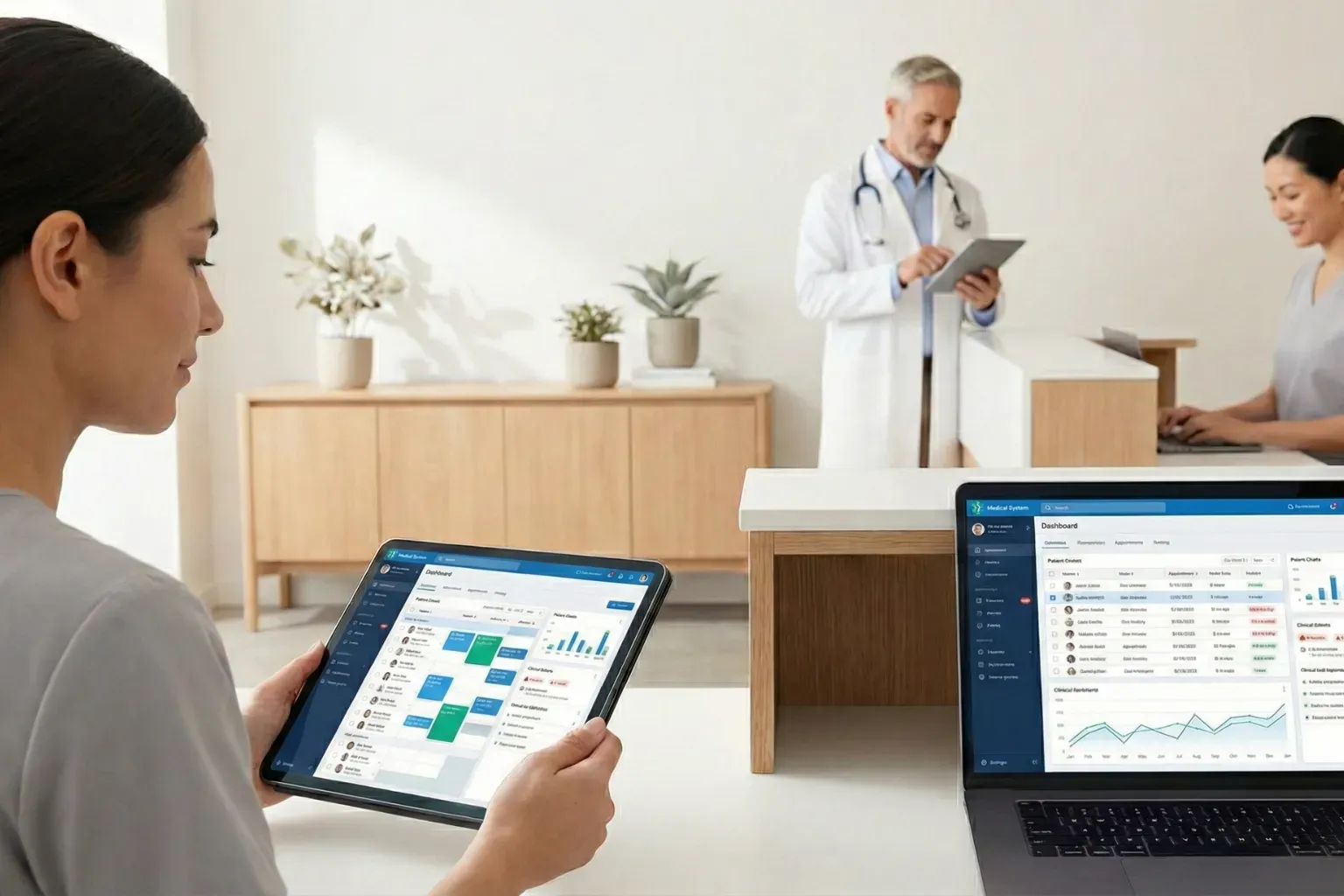
System performance on different devices (desktop, tablet, smartphone).
Support also plays a major role. Tools like Ninsaúde Clinic offer assisted implementation, training, and a customer success team, which makes the transition easier and reduces resistance. A good vendor doesn’t just deliver software; it supports the clinic through process changes and increased digital maturity.
Cost vs. Value: Looking Beyond the Subscription Fee
U.S. clinics tend to evaluate the total cost of ownership (TCO), not just the subscription price. This includes not only what is paid to the vendor, but also the operational impact.
Some elements considered:
Monthly fees per user, provider, or location.
Implementation, data migration, and additional training costs.
Charges for add-on modules or specific integrations.
Time saved through automation of scheduling, communication, and billing.
Reduction in no-shows, recording errors, and write-offs.
A useful exercise is to compare the current situation to the projected scenario:
How much time does reception spend rescheduling visits because patients forgot?
How many procedures fail to be billed correctly?
How many physician hours are consumed by repetitive documentation?
A Practical Decision Framework Inspired by U.S. Clinics
In practice, many clinics follow a similar framework:
Map processes and pain points
Document how scheduling, care delivery, billing, communication, and reporting work today. Identify bottlenecks, risks, and rework.
List essential and desirable requirements
Group them into blocks: security, medical records, billing, scheduling, integrations, reporting. Mark what is non-negotiable and what is a differentiator.
Build a shortlist of vendors
Select a few solutions with a track record in similar clinics, analyzing reputation, time in the market, and success stories.
Request demos guided by the real workflow
Ask the vendor to simulate a full day of care: scheduling, check-in, visit, billing, and analytics.
Test with the team
Involve reception, clinicians, and finance, collecting structured feedback on usability and process fit.
Run a controlled pilot
Implement in one location or group of providers for a defined period, measuring impact on productivity, billing, and satisfaction.
Turning Software into a Strategic Ally for the Clinic
When we look at how clinics in the United States choose their systems, it becomes clear that software is no longer just a “computer program” and has become a strategic component of the business. It organizes workflows, connects departments, strengthens the relationship with patients, and protects the financial sustainability of the operation.
For healthcare managers, the lesson is straightforward: start with a deep understanding of your own processes, turn that vision into objective criteria, and look for technology partners capable of growing alongside the clinic. By following this logic—and considering complete solutions like Ninsaúde Clinic when appropriate—the choice of software stops being a risk and becomes an opportunity to raise the level of management, efficiency, and quality of care in any market where the clinic operates.

Enjoyed these insights?
Keep following our blog for more content on clinic management, medical marketing, and healthcare innovation.
Are you a healthcare professional who hasn’t tried Ninsaúde Clinic yet? Discover how the platform can streamline processes and elevate the quality of patient care.
