

Choosing the right clinical practice management system has become a strategic priority for medical groups, specialty practices and multi-location clinics in the United States. With increasing operational complexity, growing patient expectations and stricter privacy regulations such as HIPAA, the question many administrators ask is: Clinical practice management system — which one is the best?
In today’s environment, a top-performing system is not just one that schedules appointments or stores patient data. It must coordinate clinical, financial and administrative workflows, automate communication, support EHR customization, integrate with telehealth, and deliver actionable insights through analytics.
In this article, we’ll break down what truly differentiates the best practice management systems in the U.S. market and compare the leading features found in American solutions.
Why choosing the best clinical practice management system matters
A poorly chosen system can slow down the practice, generate rework, frustrate staff and undermine patient satisfaction.
A well-designed solution, on the other hand, can:
- Reduce administrative burden
- Increase scheduling efficiency
- Improve financial predictability
- Lower patient no-show rates
- Standardize workflows
- Strengthen compliance with HIPAA
- Provide a smoother patient experience
Essentially, choosing the best practice management system means giving clinical teams more bandwidth to focus on patient care instead of operational obstacles.
Key criteria that define the best practice management system
Below are the factors that U.S. clinics typically evaluate before adopting or switching systems.
1. Financial and billing support
The U.S. healthcare market relies heavily on insurance reimbursements. Therefore, a strong system needs:
- Eligibility verification
- Payment posting automation
- Patient-facing payment tools
- Revenue cycle insights
Practices that rely on outdated billing processes often face delays, denials and lost revenue.
2. Usability and speed of implementation
American clinics value systems that reduce training time. A top-tier solution must have:
- A clean, intuitive interface
- Rapid onboarding
- Accessible support channels
- Minimal disruption to daily operations
Because U.S. patient volume is often high, slow or overly complex systems can quickly become bottlenecks.
3. HIPAA compliance and data security
In the United States, health data protection is non-negotiable. A compliant system must offer:
- Encryption at rest and in transit
- Access controls and audit logs
- Secure cloud hosting
- Business Associate Agreements (BAA)
- Strong identity verification for e-signatures
The best systems also help clinics maintain internal compliance processes.
4. Integration capabilities
An essential factor for U.S. practices is the ability to integrate with:
- EHR platforms
- Labs and imaging centers
- Telehealth partners
- Pharmacy systems
- Billing/RCM solutions
- BI dashboards (Power BI, Looker Studio, Tableau)
Systems with open API support offer more scalability and customization.
5. Workflow automation and operational efficiency
The best systems do more than organize a calendar — they automate tasks that consume staff time. U.S. practices benefit most from systems that offer:
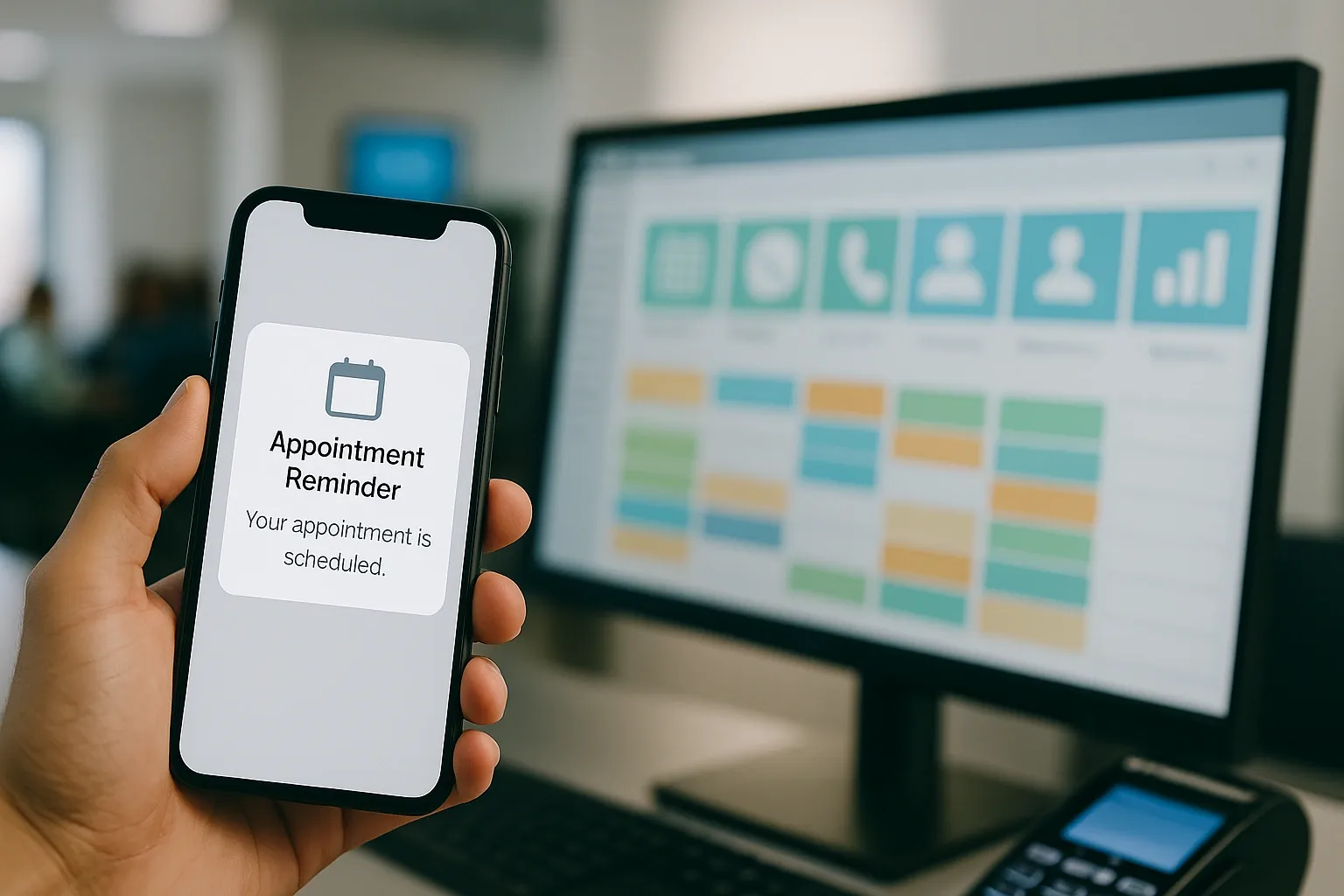
- Automated reminders (SMS, email, phone)
- Real-time scheduling updates
- Digital check-in and intake forms
- Built-in telehealth
- Auto-populated documentation
- Integrated billing and claims tracking
Automation is especially critical for larger practices and high-volume specialties.
6. Reliable, human-centered support
Support is a major differentiator in the American market. Clinicians and administrators favor systems that offer:
- Real-time support (phone, chat, email)
- Fast resolution
- Implementation assistance
Delayed support directly impacts patient care, making it a key decision factor.
Comparison of practice management systems in the United States
Below is a feature comparison between commonly used system types in the U.S. market.
Competitors are named generically ("Software A", “Software B”) to maintain neutrality while focusing on functionality.
Comparison Table — U.S. Practice Management Systems
| Criteria | Ninsaúde Clinic | Software A | Software B | Software C |
|---|---|---|---|---|
| Flexible scheduling (multi-location) | ✔️ Advanced | ✔️ Basic | ✔️ Intermediate | ❌ Limited |
| Automated reminders (SMS/email) | ✔️ Included | ❌ Not native | ✔️ Partial | ✔️ Included |
| EHR customization | ✔️ Advanced | ✔️ Limited | ✔️ Intermediate | ❌ Fixed templates |
| Digital & legal e-signatures | ✔️ Available | ❌ Missing | ✔️ Basic | ❌ Missing |
| Telehealth integration | ✔️ Unlimited | ✔️ Limited | ✔️ Limited | ❌ Missing |
| Financial/RCM tools | ✔️ Complete | ❌ Basic | ✔️ Moderate | ❌ Lacks structure |
| Open API integrations | ✔️ Fully open API | ❌ Closed | ✔️ Partial | ❌ No API |
| Automated patient intake/check-in | ✔️ Available | ❌ Missing | ✔️ Partial | ❌ Missing |
| Analytics & reporting | ✔️ Advanced dashboards | ✔️ Basic | ✔️ Intermediate | ❌ Minimal |
| HIPAA compliance | ✔️ Strong | ✔️ Moderate | ✔️ Basic | ❌ Weak |
| Scalability for multi-specialty | ✔️ High | ❌ Low | ✔️ Medium | ❌ Low |
| Additional features | AI tools, CRM, digital payments, multi-unit management | Basic | Moderate | Basic |
What the U.S. comparison reveals
The comparison highlights an important pattern: many systems offer essential features, but only a few combine automation, interoperability, financial intelligence and customization at a high standard.
A strong differentiator in the U.S. market is open API flexibility, which enables practices to integrate tools and build their own data ecosystem — something increasingly valued by multi-specialty groups and enterprise-level clinics.
Support quality also plays a huge role, as delays in resolving issues can directly affect billing timelines and patient satisfaction.
Before we move on, one important note: if you manage a healthcare clinic and need better scheduling organization, a secure electronic health record, and centralized financial processes, Ninsaúde Clinic can streamline your daily operations. Get in touch to learn more.

When is a system considered the “best”?
In the U.S., the best practice management system is the one that:
- Simplifies documentation
- Reduces operational cost
- Improves patient flow
- Reduces denials and billing delays
- Supports telehealth and remote care
- Provides accurate analytics
- Enhances patient communication
- Protects PHI with strong HIPAA safeguards
The best system is not necessarily the one with the most features but the one that aligns tightly with the clinical workflow.

Signs it's time to switch systems
If your clinic experiences any of the following, the system may be holding you back:
- Staff relies on spreadsheets or multiple apps
- Documentation is rigid or hard to customize
- No API or integration options
- Reports don’t support data-driven decisions
- Billing errors or delays are frequent
- Support takes too long to respond
- Telehealth requires external platforms
- Patient no-shows are high due to lack of automation
In the highly competitive U.S. market, falling behind in technology means losing efficiency — and revenue.
How to choose the best practice management system for your clinic
Use this objective checklist:
1. Map your operational needs
Scheduling, reminders, documentation, billing, analytics, telehealth, multi-location support.
2. Prioritize automation
Automation saves time, reduces errors and boosts productivity.
3. Evaluate EHR flexibility
Specialties like cardiology, orthopedics, pediatrics and dermatology require tailored workflows.
4. Assess integration capabilities
A system without strong integration tools limits growth.
5. Confirm HIPAA compliance
Ensure strong data protection, audit logs and secure hosting.
6. Request demos
Seeing the system in action helps clarify real usability.

Clinical practice management system — which one is the best?
In the U.S., the best system is the one that balances technology, automation, interoperability, financial intelligence, and data security without overwhelming your team.
Solutions that offer open API, advanced EHR customization, telehealth, automation and robust reporting tend to deliver the strongest long-term performance.
While many platforms provide essential features, only a few combine all of these capabilities into one cohesive ecosystem — which is what growing practices need to stay competitive.
Enjoyed these insights?
Keep following our blog for more content on clinic management, medical marketing, and healthcare innovation.
Are you a healthcare professional who hasn’t tried Ninsaúde Clinic yet? Discover how the platform can streamline processes and elevate the quality of patient care.
